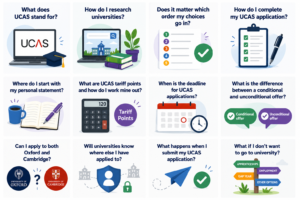
Here you’ll find answers to some of the most common questions we receive about UCAS applications and university.
What is UCAS?
UCAS (Universities and Colleges Admissions Service) manages the application process for higher education courses in the UK. It provides an online application system, course search tools, and free information and advice.
How do I research universities?
UCAS is a great place to start your research. You can use its course search tool to explore courses, check entry requirements and review module information.
University league tables, websites and Open Days can also help you compare your options and make informed decisions.
Learn more about researching universities.
Does it matter which order my choices go in?
No. The order of your choices does not affect how universities consider your application.
You can apply for up to five choices, but you do not have to use all of them.
How do I complete my UCAS application?
Here are some tips and tricks to help complete your UCAS application.
Where do I start with my personal statement?
Stuck on what to write? Here’s some guidance to get you completing your personal statement in no time.
What are UCAS tariff points and how do I work mine out?
UCAS tariff points can be pretty confusing, here’s a guide to UCAS tariff points for your qualification.
When is the deadline for UCAS applications?
For most undergraduate courses, the deadline is in January, four months after the start of the academic year.
For Oxbridge, dentistry, medicine, veterinary medicine or veterinary science applications, the deadline is October, a month after the start of the academic year.
Always check the UCAS website for the latest deadlines, as dates can change each year.
What is the difference between a conditional and unconditional offer?
Conditional
A conditional offer means you must meet specific entry requirements, usually by achieving certain grades or qualifications.
Unconditional
An unconditional offer means you have already met the university’s entry requirements and have been offered a place regardless of your future results.
Can I apply to both Oxford and Cambridge?
Unfortunately, you can only apply to either Oxford or Cambridge. So consider this before applying.
Will universities know where else I have applied to?
Universities cannot see where else you have applied while they are considering your application.
Once you have responded to your offers, universities may be able to see information relating to your accepted choice.
What happens when I submit my UCAS application?
Once you submit your application, UCAS will process it and send it to your chosen universities. You can track the progress of your application through your UCAS Hub account.
What if I don’t want to go to university?
University is just one progression route. There are many alternatives available, including apprenticeships, employment, higher technical qualifications and gap year opportunities.
Learn more about your options instead of university.
If you have a question that has not been answered here, please speak to your tutor or contact Activate Careers.
Please note, information about UCAS processes and deadlines can change. Always check the UCAS website for the most up-to-date guidance.
Other progression resources
- What are UCAS tariff points?
- University level qualifications explained
- Researching universities and your options instead of university